RETAINING WALL BLOCKS
For years Cape Brick's retaining wall blocks have been successfully used in a myriad of applications, ranging from engineered retaining walls to aesthetically pleasing landscape solutions.
Following increasing demand and positive feedback from our long-standing clients we have made a minor alteration to our product range. Whilst available to order in almost any colour, our stock colour has been changed to "sandstone". This colour reflects a more natural "earthy" feel and allows the blocks to blend with the environment on a greater variety of sites.
The blocks are available in both a smoothface and a rockface finish, allowing greater flexibility in the design of your wall. You can leave your wall bare to create a textured rockface finish or plant it up with a variety of suitable plant species to create a completely natural looking and invisible retaining wall.
In keeping with our commitment to "Building A Better Environment With Recycled Materials", 50% of the raw materials used in the manufacture of the blocks are recycled. The end result is an attractive and natural retaining wall solution.
|
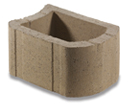
CODE: RWB SF-SS |
| DESCRIPTION: R 12 Sandstone Smoothface Retaining Block. | |
| SIZE: 380 x 300 x 220 | |
| MASS: 27.00 Kgs | |
| MPA: 10 | |
| No./Mz: 12 | |
| No./PLT: 48 |
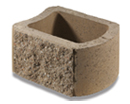 |
CODE: RWB RF-SS |
| DESCRIPTION: R12 Sandstone Rockface Retaining Block | |
| SIZE: 385 x 320 x 220 | |
| MASS: 28.00 Kgs | |
| MPA: 13 | |
| No./Mz: 12 | |
| No./PLT: 36 |
PLANNING
* Measure the length and height of the proposed wall and multiply these two
numbers to calculate the surface area. Multiply this number by 12 to obtain
the number of blocks required (excluding cutting and wastage).
* Retaining walls must comply with local building regulations.
* A rule of thumb is, where the wall is less than 1.2 meters high and where
soil and drainage conditions are good, there should be no need for an engineer.
In all other instances the services of an engineer are required.
INSTALLATION GUIDE
* Measure the wall layout & mark
the course using string and stakes.
* Dig a trench 400mm deep, 600mm wide and create either compacted gravel or
a concrete base 200mm deep. (Gravel foundations are usually sufficient for
walls under one (1) meter in height) It is imperative that the foundation
is level in all directions.
* Place first row of blocks upside down (smoothest edge down) on the foundation,
ensuring blocks are level in all directions.
* For steep and high walls the first layers can be filled with concrete and/or
steel bars for extra stability.
* Place a flexible perforated drainage pipe, 75 - 110mm in diameter, behind
the first layer of blocks, wrap this in filter fabric. Ensure that 19mm gravel
is wrapped in filter fabric around the drainage pipe. The gravel layer should
be at least 400mm wide and 220mm deep. See "Typical Section" diagram.
* To achieve desired angle of wall, refer to setback table to select correct
setback distance.
* Remember to fill all consecutive blocks with topsoil if these are to be planted
up, and to compact blocks and backfill. Behind all layers there should be a
layer 300mm wide of compacted drainage material, such as free draining sand.
* When specified, install geofabric on compacted backfill and wedge between
blocks. Shear keys are to be installed where specified by engineer.
* Your wall is now ready either to be planted up or to be left as is.
TYPICAL SECTION

Setback table for Cape Brick |
||||||||
| Wall Angle | 50 | 55 | 60 | 65 | 70 | 75 | 80 | 85 |
| Setback in mm | 185 | 154 | 127 | 103 | 80 | 59 | 39 | 19 |
Block infill Information |
||||
| Units per m2 | Block Mass kg | Block Infill Volume m3 | Mass of wall incl. Soil kg/m2 | |
| Smoothface | 12 | 27 | 0.013 | 549 |
| Rockface | 12 | 28 | 0.013 | 561 |
PLANTING SUGESTIONS
| SUN | SHADE | DRY | WATER | SW CARE | |
| Trailing Phlox Sutera Cordata | • | • | • | • | |
| Kooigoed Helichrysum Petiolare | • | • | • | ||
| Star Jasmine Trachelospermum jasminoides | • | • | • | • | |
| Ghost Plant Kalanchoe Waldheimii | • | • | • | • | |
| Rooi-ogie Aptenia cordifolia | • | • | • | ||
| Sour fig/Suurvy Carpobrotus edulis | • | • | • | • | |
| Parrot's Beak Lotus | • | • | • | • | |
| Bloublombossie/Wild Aster Felicia filifolia | • | • | • | ||
| Botterblom/Briungous blom Gazania krebsiana | • | • | • | ||
| Strandgousblom Gazania rigens | • | • | • | • | |
| Erigeron Erigeron Kavrinskianus | • | • | • | • | |
| Gig green leaved ivy Hedera canariensis "Mosaik" | • | • | • | • | |
| Ivy Hedera helix "Goldheart" | • | • | • | • | |
| Creeping Foxglove Asystasia gangetica | • | • | • | • | |
| Blue-and-white daisy bush Osteospermum ecklonis | • | • | • | ||
| Moss Verbena Verbena tenuisceta mauve | • | • | • | • | |
| Wildemalva Pelargonium cucullatum | • | • | • | ||
| Ivy-leaved pelargonium Pelargonium peltatum | • | • | • | • | |
| Lekkerstink -salie Plectranthus amboinicus | • | • | • | • | |
| Carpet Geranium Geranium incanum | • | • | • | • | |
| Periwinkle Vinca major "Marginata" | • | • | • | ||
| Vygie Vygie various species | • | • | • |
All information given is based on an "average" installation and is not intended to replace the services of a qualified installer. No liability will be accepted by Cape Brick for any claims resulting from the use of these guidelines. All information is given in good faith without warranty and no liability is accepted. Sole responsibility rests with the user who must ensure that a professional engineer is engaged to design and supervise the installation and that the wall is up to local government specifications.
E & O.E.