INSTALLATION GUIDELINE - GreenLock V12 Block
Planning
- Measure the height and length of the proposed wall and multiply these two numbers together to calculate the surface area. Multiply this number by 12 to obtain the number of blocks required
- Retaining walls must comply with local building regulations.
- A rule of thumb is, where the wall is less than 1.2 meters high and where soil and drainage conditions are good, there should be no need for an engineer. In all other instances the services of a qualified engineer are required.
Typical Installation
- Measure the wall layout and mark the course using string and stakes.
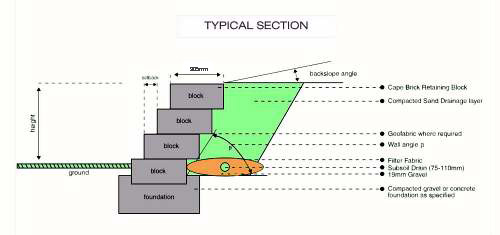
- Dig a trench 400mm deep, 600mm wide and create either compacted gravel or a concrete base 200mm deep. (Gravel foundations are usually sufficient for walls less than one (1) meter in height.) It is imperative that the foundation is level in all directions.
- Place the first row of blocks in the wet concrete ensuring all degree markers line up correctly.
- Each marker (inset dimple) on the block represents a 10º (ten degree) change in angle. For a twenty degree curve, line up the second marker with the main marker. A maximum turn of 105º can be achieved. The seven markers on the large circumference of the block represent an angle of 45 ° between each marker.
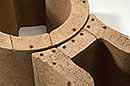 |
The 45° marker on the back block lines up with the centre marker on the front block, means that there is a 45 ° angle between the blocks. |
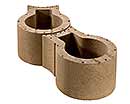 |
The 45° marker on the back block lines up with the 10° marker on the front block giving an angle of 35° between the blocks. |
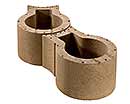 |
The 45° marker on the back block lines up with the 10° marker on the front block giving an angle of 35° between the blocks. |
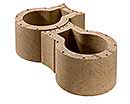 |
The 90° marker on the back block is lined up with the middle marker on the front block giving a right angle turn to the wall. |
- For steep and/or high walls the first layers can be filled with concrete and/or steel bars for extra stability.
- Place a flexible perforated drainage pipe, 75-110mm in diameter, behind the first row of blocks, wrap this in filter fabric. Ensure that 19mm gravel is wrapped in filter fabric around the drainage pipe. The gravel layer should be at least 400mm wide and 220mm deep.
- To achieve the desired angle and setback of the wall, refer to the supplied setback table. (The setback distance is measured from the outermost part of the block. A setback of less than 21mm will allow soil to fall through the block and a setback of 63mm will align the concave and convex sections of alternative layers.)
- Remember to fill consecutive blocks with topsoil if these are to be planted up and remember to compact blocks and backfill. Behind all layers there should be a layer of minimum 300mm wide of compacted drainage material, such as free draining sand.
- Your wall is now ready to be planted up or left as is.
All information provided is based on an “average” installation and is not intended to replace the services of a qualified engineer. No liability will be accepted by Cape Brick for any claims resulting from the use of these guidelines. All information is given in good faith without warranty and no liability is accepted. Sole responsibility rests with the user who must ensure that a professional engineer is engaged to design and supervise the installation, and that the wall adheres to local government specifications. Why use an engineer?
For additional information contact us for a free CMA Retaining Wall Block Brochure.
E. & O.E. |