*Training videos are available.
NB: Do not proceed with jointing if any faults remain from the previous stage of erection (Refer to data sheet for Rhino Drywall Wallboard Cladding Application).
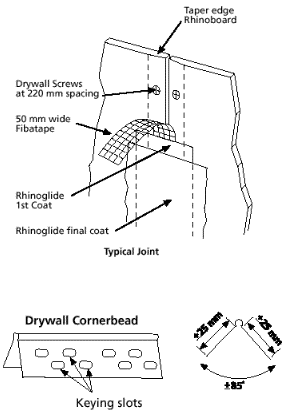
1. Check board surface.
Any repairs and/or joints wider than 5 mm should be prefilled with Rhinoglide.
Pull off any loose paper and retape where core is exposed.
2. Apply self-adhesive
fibatape over the centre of the joint.
3. Apply 1st layer of Rhinoglide using a 125 mm taping knife (putty knife).
Clean off edges. Allow to set. 4. Apply 2nd layer of Rhinoglide using a 300
mm trowel. Clean off edges and allow to set.
5. A butt joint can be taped in the normal way using Rhinoglide. (As No.2 &
3). When set, apply the 2nd layer of Rhinoglide to each side of the tape with
a 300 mm trowel. Clean off the outside edges. When set, apply the 3rd layer
over the centre of the joint and allow to dry.
6. Apply Fibatape to internal corner ensuring that the tape is evenly spaced
either side. Apply a coat of Rhinoglide to one side using a 125 mm taping knife.
Allow one side to set before beginning the other side. 7. To fit corner bead
onto the external corner, apply a layer of Rhinoglide to each side of the corner
bead. Press the corner bead firmly into postion. Using a 125 mm taping knife
apply bead. When set apply a second layer using a 250 mm trowel. Clean off the
outside edges
8. Screws can be flushed using a 125 mm taping knife. Apply a small amount of
Rhinoglide over the screw head in one direction and wipe in a right angle direc-tion.
Apply 2nd coat in the same way. Note: Allow to set between
each coat.
9. A control joint is fitted between brickwork and drywall where they are in
the same line or as an expansion joint on a long continuous Rhino Drywall, e.g.
walls longer than 10 m should have a control joint every 5 m. Note that a full
height door frame acts as a control joint. Allow 1 cm gap between Rhinoboard
and brickwork. Butter this joint with Rhinoglide, then press control joint firmly
into posi-tion. Joint in normal manner.
10. When all final coats are set, sand lightly to a smooth level finish using
a fine grit sand paper (100 grit). Do not oversand.
NB (1): In points 2-9 it must be remembered to clean off
all excess Rhinoglide and feather out.
NB (2): Using a damp cloth remove all powder from the
joint and surface of board prior to decoration.
DECORATION
For improved paint finishes, it is suggested that a good quality plaster primer
be used on the entire surface.
CHECK LIST 1.
Make sure that the Rhinoglide is allowed to set thoroughly between coats.
2. Check that the screws and metal trims are completely covered with compound.
3. Check that all finished joints are smooth and dry for decoration.
4. Check surface generally for smoothness and possible unfinished work.\
*Training videos are available.