The Franke Group
Franke was established in 1911 in Switzerland by Walter Franke. Today,
Franke is active worldwide with operations in 32 countries. Around 5000 skilled staff are employed in 60 operative Group companies. The company also operates an international network of approved distributors.
The company's most traditional field is in Kitchen Systems. Franke
is the worlds leading supplier of kitchen sinks. The companies in the
Kitchen Systems Division also supply designer taps, cooking hobs, extractor hoods and food preparation accessories designed to match their sink ranges. The
Washroom and Sanitary Equipment Division supplies products for use in
public washrooms, hospitals, schools, etc. and operates from
within the Kitchen Systems Division.
As a recognised partner and general contractor for catering equipment, Frankes Contract Group, works mainly with multi-unit food services establishments, e.g. MacDonalds worldwide.
In the area of Beverage Containers, Franke supplies the beer, wine, foodstuffs and mineral water industries throughout the world with stainless steel beverage containers.
In the field of Food Service Equipment, Franke produces and sells heating and cooling appliances as well as coffee machines and standardised products for the catering trade.
In the Industrial Technology sector, components, tools and products are manufactured for aerospace, gas turbines and the transport and security industries as well as for the motor industry.
All the above mentioned businesses make up Franke’s fourth division, called the
Diversified Products Division.
The Kitchen Systems Division
Sink units were the first industrial product made by
Franke. To date over 50 million
sinks have left the
Franke production plants and ensure satisfied customers throughout the world. Mass production commenced in 1925, initially from nickeline, later from chrome and nickel chromium steel. In 1973 the coloured, enamelled
sinks went into production, and in 1979 the now world-famous
Franke
compact sink system was introduced. The marketing of
Fradura synthetic sinks started in 1984. Since the Carron Group was taken over in 1990,
Franke has been running a technology centre for synthetic processing to support the production of
high quality synthetic sinks in Fraquartz and Fragranit material.
The most important product groups are:
- Inset sinks in nickel chromium steel, enamelled steel, ceramics and high-grade synthetics
- Drop-on sink units in nickel chromium steel
- Standard or customised special work tops in nickel chromium steel
- Cooking hobs in nickel chromium steel or enamel (electric and/or gas) as well as
glass-ceramic hobs
- Built-in ovens and canopies
- Kitchen taps and water treatment systems
- Waste disposal systems
- Sink/food preparation and cooking centres for semi-professional kitchens
- Accessories of all kinds
The Washroom and Sanitary Equipment (WSE) product group has been firmly established in the
Franke group since 1930 with a wide variety of WSE products to cover the full range of equipment for
communal washrooms and WCS.
Franke Kitchen Systems South Africa
Franke holding wrapped up its first acquisition on the African
continent by acquiring
City Metal Products (CMP), which previously belonged to Boumat Ltd.
Franke acquired the
leading manufacturer and distributor of sinks and sanitary products in South Africa. Over the last two decades CMP managed not only to consolidate its position as a market leader through local acquisitions, but also to adjust successfully to the economic changes in South Africa. In previous years the company invested intensively in new production technologies and launched new products for the export market.
Franke intends to build up its market presence on the African continent with its new acquisition. As a new member of the
Franke Group, CMP was renamed
Franke Kitchen Systems (Pty) Ltd, t/a
Citimetal and is active in the
Kitchen Systems Division and
Washroom and Sanitary Equipment.
Franke Kitchen Systems will continue to produce and market products in its designated markets, using both the "Franke" and "Citimetal" brand names.
Making use of the technically advanced mono-block technology, Franke Kitchen Systems produces a competitive range of
quality inset sinks.
Kitchen Facts
A sink is not just a sink
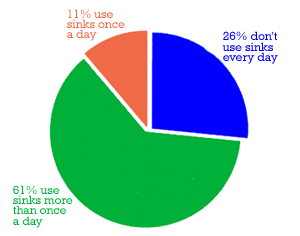
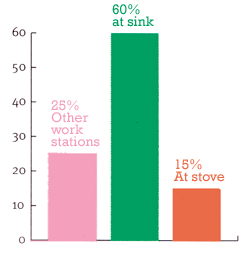
Current statistics prove that the "washing up area" is the most commonly used space in modern kitchens. In fact, up to 60% of all cleaning activities happen at the
kitchen sink. Even though dishwashers have become increasingly popular over the years as a more hygienic, more efficient option than washing up by hand, people still spend two thirds of their time in the kitchen at the
sink.
This is because a sink is no longer just a sink. With products on the market like the attractive
Franke Papillon, with its ample bowl space and range of accessories, including a bowl strainer, chopping board, stainless steel drying rack and basket, the
sink area has become a beautiful, but highly sophisticated workstation, designed specifically for hygiene, comfort and speed.
Even if you own a dishwasher, all washing and cleaning of food, cutting, defrosting, rinsing and cleaning of delicate items can be accommodated by any one of our
wide variety of sinks.
Care and maintenance
Useful Advisory Chart
| Situation/Problem
|
Solution
|
Notes and comments
|
Routine cleaning
All grades and finishes
|
Inox Creme applied
with soft cloth or sponge. Rinsed and wiped dry.
|
If possible, use a warm to hand-hot solution. A
5% addition of ammonia is beneficial.
|
Fingerprints
All finishes
|
Pretreat marks with alcohol or an organic
solvent. Follow immediately with Routine
Cleaning.
|
Minimise reoccurrence by applying a wax or
silicone based household polish to the clean,
dry surface.
|
|
Stubborn stains and discolouration - all
finishes except coloured stainless steel
|
Use a small amount of a creamy paste of mild
household abrasive cleaner on cloth wetted with
detergent solution as for Routine Cleaning.
Rinse and dry.
|
Repeat several times rather than resorting to a
single aggressive cleaning method. If stubborn
stains persist use a fine synthetic scourer pad
instead of a cloth. Rub gently.
|
|
Lime scale deposits from hard water
|
Prolonged soaking in a 25% vinegar solution or a
5% nitric acid solution. Periodically rub with a
nylon bristled brush or fine synthetic scourer
pad.
|
Can usually be prevented by regular Routine
Cleaning. Do not allow excessive buildup before
treating.
|
Grease, fats and oils
- all finishes
|
Wipe off excess with soft cloth or paper towel.
Use a water borne or water soluble degreasing
agent. Follow by Routine Cleaning.
|
|
|
Rust marks due to presence of or contact with
ferrous materials
|
If heavy, swab with a sponge wetted with a
dilute (10-15%) solution of nitric acid (HNO3).
Follow by Routine Cleaning.
|
Avoid any contact of ferrous (iron containing)
materials with stainless steel. Dilute nitric
acid (HNO3), in
strengths of up to 20%, is a "friendly" acid to
stainless steel. It is the ONLY acid which may
be used with no risk to stainless steel. |
|
Dark oxide scale from welding or heat tints.
|
Pickling and passivating plus thorough water
rinsing is outlined on previously. Follow by
Routine Cleaning.
|
Slight heat tints ma be removed by repeated
application as for Stubborn Stains and
Discolouration.
|
|
Scratches on polished (lined) finishes
|
Slight scratches. Use nylon pad loaded with iron
free abrasive polishing compound. Follow the
direction of the original polish lines. Follow
by Routine Cleaning.
|
Deep scratches will be difficult to remove
completely. Do not use metal scourers or wire
wool unless they are made from stainless steel.
|
Cleaning Procedure
Clean the Stainless steel as often as experience dictates
(i.e. when noticeably dullor dirty); and use the simplest
cleaning procedure that will effectively "do the job".
- Stainless steel's best friends are clean water
or mild detergent solution, applied with a soft
cloth or sponge, rinsed well and wiped dry.
- Routine simple, gentle and inexpensive cleaning
will retain both the corrosion resistance and
appearance of stainless steel through years of
exposure and use.
Occasionally a small amount of
Inox Creme may be used on
a soft cloth wetted with the detergent solution to
remove stubborn dirt or slight incipient stains. Rub
gently.
Cleaning Do's
- Employ regular routine cleaning rather than
accasional aggressive single cleaning.
- Only use propriety brands of cleaners that state
"Suitable for Stainless Steel", such as
Inox Creme.
- Always rinse and dry as the final step in a
cleaning procedure.
Cleaning Dont's
- Do not use coarse abrasive powders.
- Do not use metallic scourers or brushes with
metal bristles.
- Do not use the so termed "silver cleaners".
- Do not us acids (except nitric acid in specific
instances).
All Franke Stainless Steel carry a 25 year guarantee
against corrosion.