|

RHEINZINK® - Angled Standing Seam
Product Overview
 |
RHEINZINK® - Seam technology
-
A
vibrant, elegant structure even for large surfaces.
-
Feasable with
tapered surfaces as well as concave and convex rounded surfaces.
-
Prominent optical structuring of the roof surface with a ca. 12 mm
seam width.
-
Simple, efficient installation by closing just one seam
-
Rainproof lengthwise connection
-
Use
of prefabricated panels or sections
-
Panel lengths up to 16.0 m are possible
|
 |
RHEINZINK®
- Angled Standing Seam
In the realm of sheet metal technology, the angled
standing seam is a relatively new development: it has only received
mention in technical literature since the beginning of the 20th
Century. For roofs with a pitch of at least 25°, it constitutes the
norm. Compared to the double lock standing seam, seam closure of
prefabricated sections is particularly easy, as the finished angled
standing seam is created by only seaming one side. The angled standing
seam is preferred in visible areas, where the pitch of metal roofing is
higher, e.g. parapets, attics and mansard roofs; whether in traditional
vertical, diagonal or horizontal application. Although it appears wider
than the double standing seam, the angled standing seam still offers
prominent vitality and quite a slender effect to the structure of large
surfaces. |
Technology
 |
|
|
|
|
|
System Description
- Roof covering from a pitch of 25°
- Façade cladding
- Small surface cladding (fascias, attics, etc.)
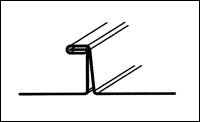
The angled standing seam is used in roof areas with pitches over 25°, in façade areas and in cladding small surfaces such as fascias, attics, parapets etc. Its height of ca. 25 mm and seam width of ca.12 mm, allows roof and facade surfaces to be divided in an aesthetically pleasing manner.
The angled standing seam is particularly notable for its low material stress. Contrary to the double lock standing seam, only one seam is closed here - either manually or by machine. The angled standing seam is produced using profilers (length ≤ 16.0 m), or folding presses (length ≤ 6.0 m).
Tapered areas as well as concave and convex rounded surfaces can be clad with the angled standing seam.
|
The angled standing seam is used in roof areas with pitches over 25°, in façade areas and in cladding small surfaces such as fascias, attics, parapets etc. Its height of ca. 25 mm and seam width of ca.12mm, allows roof and facade surfaces to be divided in an aesthetically pleasing manner.
The angled standing seam is particularly notable for its low material stress. Contrary to the double lock standing seam, only one seam is closed here - either manually or by machine. The angled standing seam is produced using profilers (length ≤ 16.0 m), or folding presses (length ≤ 6.0m).
Tapered areas as well as concave and convex rounded surfaces can be clad with the angled standing seam.
 |
|
|
|
|
|
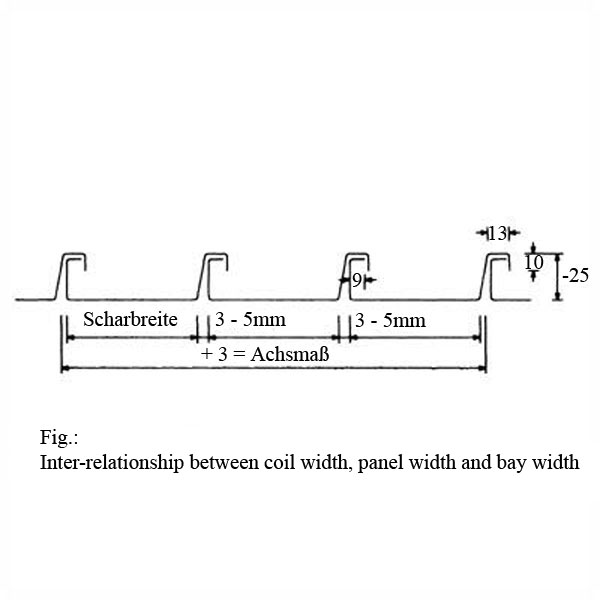
Section Width / Material Thickness
- Section widths of 400 – 600 mm
- Material thickness 0.7 mm / 0.8 mm
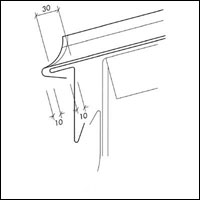
The section width of ca. 530 mm (coil width 600 mm) is the international standard for angled standing seam roofs, with a material thickness of 0.7 mm.
However, practical building experience indicates that, in exceptional cases, it is necessary to reduce the section width and increase material thickness. This can counteract possible deflections from high winds.
|
| |
|
|
|
|
|
|
 |
|
|
|
|
|
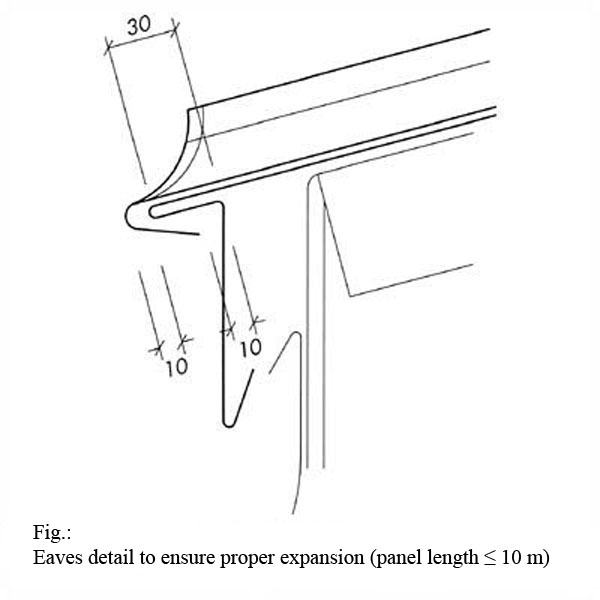
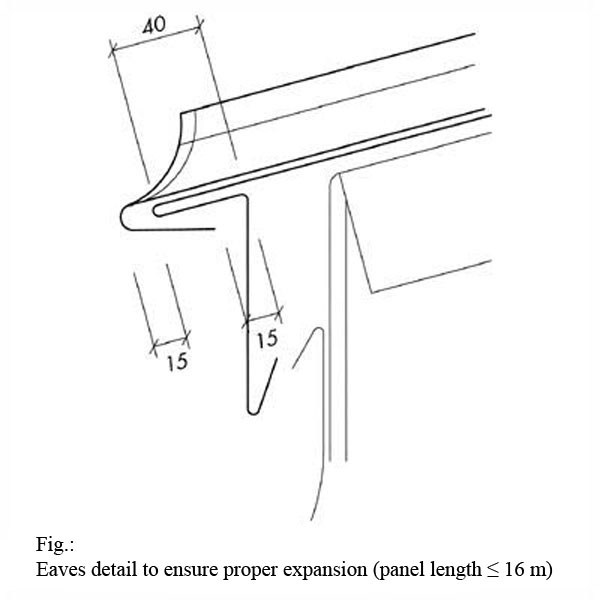
Section Lengths
- Customary section length is up to 10.00 m
- In special cases up to 16.00 m
The general standard maximum section length is 10.00 m.
In special cases, section lengths of up to 16.00 m can be installed. In this case, fastening and connection details of the sections must be adapted to increased length.
If the max. possible section length is insufficient, individual lengths may be connected with cross-joints.
|
Fixing
- Indirect via clips in the seam area
- Indirect via continuous cleats in the bends at the end of the section or panel
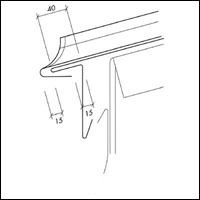
Fastening is always indirect: fasteners are attached in the seam area, or seam strips in the edges at section ends (although in some cases, individual fasteners are used there as well).
Three kind of fasteners are used: fixed clips, sliding clips and long sliding clips. The number of clips per sqm depends on wind suction forces, fasteners and roof construction. Above and beyond that, section width and material thickness also impact significantly on the number of clips required.
Band width/mm
Course width/mm*
Course width/mm**
Metal thickness /mm |
500
420
430
0.7 |
570
490
500
0.7 |
600
520
530
0.7 |
670
590
600
0.7 |
700
620
630
0.7 |
800
720
730
0.8 |
| Wind loads in kN/m² |
|
|
|
|
|
|
- 0.3
- 0.6
- 0.9
- 1.2
- 1.5
- 1.8
- 2.1
- 2.4
- 2.7
- 3.0
- 3.3
- 3.6
- 3.9
- 4.2
- 4.5
- 4.8
- 5.1 |
4/500
4/500
4/500
4/500
6/350
7/300
8/250
8/250
10/200
11/200
11/200
13/150
13/150
15/150
15/150
17/100
17/100 |
4/500
4/500
4/500
4/500
6/350
7/300
8/250
8/250
10/200
11/200
11/200
13/150
13/150
15/150
15/150
17/100
17/100 |
4/500
4/500
4/500
4/500
6/350
7/300
8/250
8/250
10/200
11/200
11/200
13/150
13/150
15/150
15/150
17/100
17/100 |
4/500
4/500
4/500
4/500
6/300
7/300
9/250
9/250
10/200
11/150
11/150
13/150
|
4/500
4/400
4/400
4/400
6/250
7/250
9/200
9/200
10/150 |
4/400
4/400
4/400
4/400
6/250
7/250
9/200 |
Table: minimum number of RHEINZINK® clips (per m²)/max. distance between clips (mm) depending on wind loads
Note: The dimension of the clip and the distance between the clips is based on an average section length of ca. 3m.
* ca. section width when hand finished
** ca. section width when machine finished
 |
|
|
|
|
|
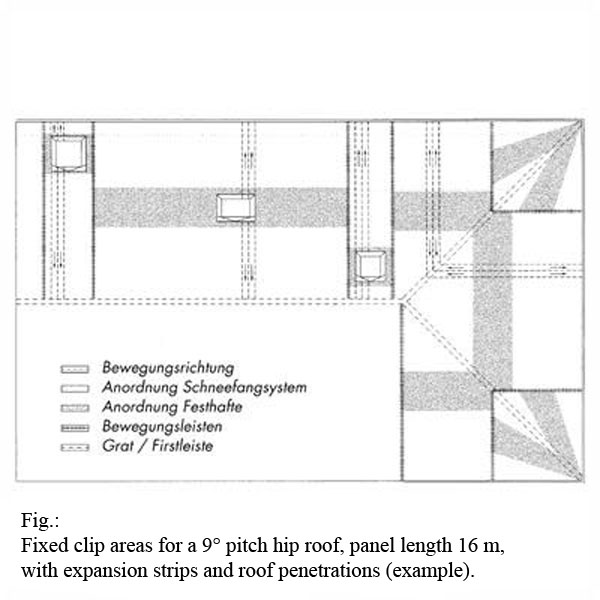
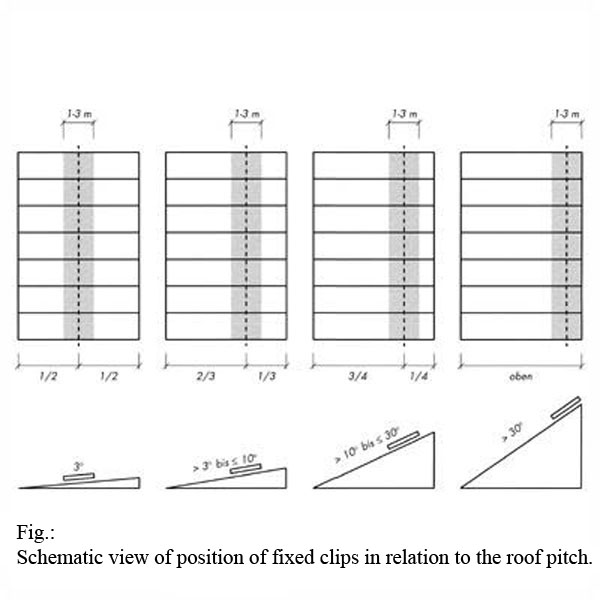
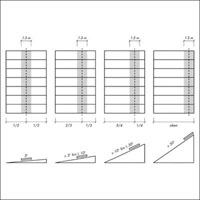
Fixed Clip Area
- Roof surface fixed clip area is between 1.0 m and 3.0 m.
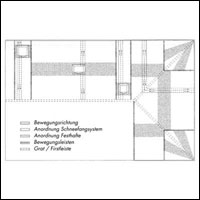
In order to prevent the sections from slipping, a fixed clip area is allocated on the roof surface, depending on roof pitch.
Depending on section length, the portion with the fixed fasteners can be between 1 and 3 m long, but not more than a quarter of the section length.
|
| |
|
|
|
|
|
 |
|
|
|
|
|
Fasteners
- Mainly flat headed nails or roofing felt nails.
In Europe, flat headed nails, roofing felt nails and/or spiral nails have become accepted fasteners.
Fixing RHEINZINK® - roofing depends primarily on the type and design of the substructure. Construction requirements must take into account snowfall and wind loads, as well as section width and material thickness, when selecting fasteners.
Fixing Media 2 each per binding
Binding metal thickness 0,8mm
|
Dimensions
(in mm) |
Quality |
typ. Use in |
Base construction
(Comments s.b.) |
| 1 |
2 |
3 |
Flat headed nail for
Compressed air nailer |
3,1x25 |
hot zinc dipped |
D |
508 |
889 |
1074 |
| Roofing felt pin |
2,8x25 |
hot zinc dipped |
D |
- |
751 |
- |
| Patented roof felt nail |
2,8x25 |
zinc-plated |
A |
415 |
- |
- |
| Chipboard screw |
4,0x20 |
zinc-plated |
DK/D |
- |
- |
1262 |
| Chipboard screw |
4,0x25 |
zinc-plated |
DK/D |
- |
- |
982 |
| Roofing felt pin, threaded |
2,5x25 |
zinc-plated |
DK |
- |
- |
1019 |
| Countersunk wood screw |
4,5x25 |
zinc-plated |
DK |
- |
- |
533 |
| Threaded nail |
3,5x30 |
coated |
S |
829* |
- |
1091* |
| Threaded nail |
2,4x30 |
zinc-plated |
F |
791* |
787* |
- |
| Felt nail |
2,5x25 |
hot zinc dipped |
F |
- |
503 |
- |
| - |
The combination was not taken into consideration when measuring. |
| * |
As expected, the extraction values are higher in 30 mm thick wooden sheathing. |
| 1 |
Ta/Fi 24 mm wooden sheathng, V13 glass fibre bitumen roof sheeting |
| 2 |
Ta/Fi 24 mm wooden sheathing |
| 3 |
Building veneer plywood, waterproof, glued, 19mm, structured underlay |
Table: medium static extraction values (in Newtons) of standard fasteners for RHEINZINK® seamed roofs and façades, depending on the substructure.
 |
|
|
|
|
|
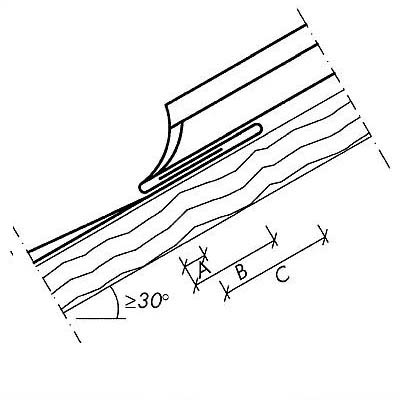
Cross-Joints
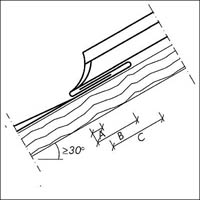
- Single cross-seam from a roof pitch of ≥ 25°.
To separate excessively long section lengths and for design reasons, cross-joints can be formed. The development of cross-joints depends on roof pitch.
|
Simple cross-seam
- The simple cross-seam can be used as a cross-joint for roof pitches of ≥ 25°.
The back-fold of the bottom section is hooked into the back-fold of the top section. Care must be taken to ensure that linear expansion due to changes in temperature is not impeded. |