RHEINZINK® - Double Standing Seam
Product Overview
 |
RHEINZINK® - Double Standing Seam
|
 |
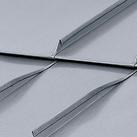
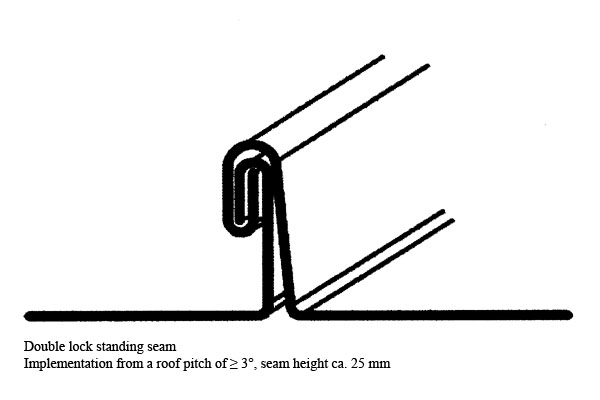
RHEINZINK® - Double Standing Seam With respect to the material zinc, the dual standing seam counts as a development of the original wooden seam / simple standing seam. Since literature of 1899, it has been the clear preference over other systems, for rooves with a slope of under 25° (minimum slope 3° or 5%). The name "dual standing seam" is characteristic of one of the of the classic long connection types - courses installed alongside one another, outside of the water level. At a minimum seam height of 23 mm, the dual standing seam is rain proof without any additional treatment. The 25 mm high, dual standing seam produced with with pre-shaped courses has gained international acceptance. The profile is tilted and closed manually or by machine, using shaping machines. It is even possible to produce special shapes such as convex and concave curves or conical course without difficulty. The multitude of possible detail variations in the dual standing seam offers a subtle emphasis of shape and looks equally appropriate with both traditional architecture and modern designs. |
Technology
 |
System Description
The dual standing seam can be used for roof slopes from 3°. The profile edges are manufactured using roll forms or by hand. Seams are also closed either using a seam closing machine or by hand. |
|||||
 |
Course Width / Metal Thickness
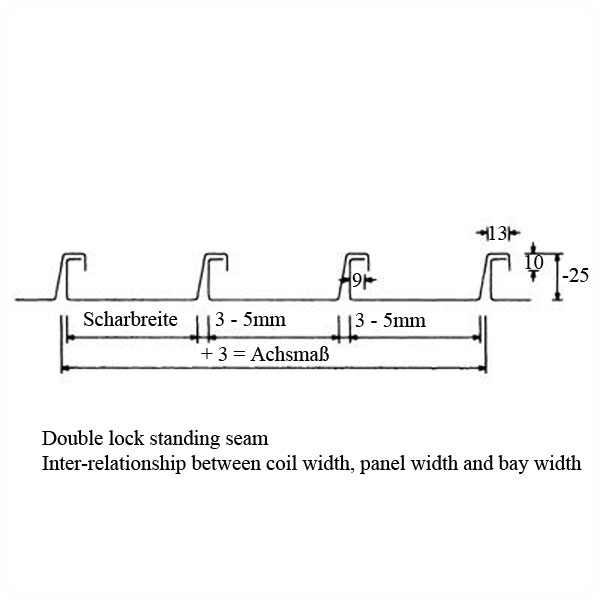
However, building practise experience dictates, in exceptional cases, that it is necessary to reduce the course width and increase the metal thickness. This can counteract possible deflections from high winds. Note: Small waves in the courses can occur, due to specific material tensions for thin sheets. |
|||||
 |
Course Length
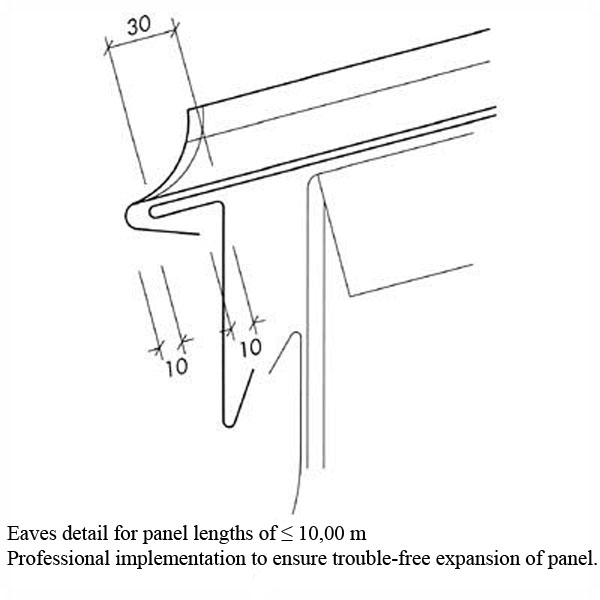
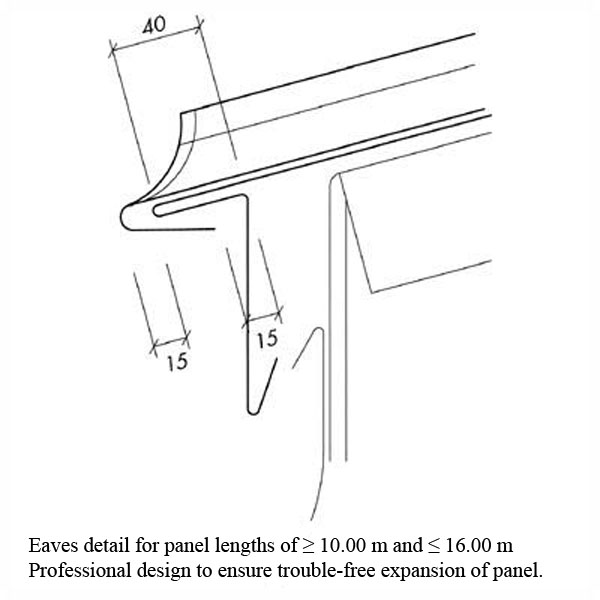
In special cases, courses of up to 16.00 m long can be installed. In this case, the fixing and connection details for the course must be adapted to the increased length. If the max. possible course length is insufficient, then individual lengths may be attached with cross-joins. |
Fixing
- Indirect via bindings in the seam area
- Indirect via binding strips in the tilts on the course end
Fixing is basically indirect via bindings in the seam area or binding strips in the tilts on the course end (in certain cases, individual bindings here as well).
Bindings are classified as fixed bindings, sliding bindings and long-sliding bindings. The number of bindings per sq m depends on the prevailing wind strengths, the fixing media and the roof construction selected. Further, the course width and metal thickness also significantly influence the number of bindings required.
Coil width/mm |
500 420 430 0.7 |
570 490 500 0.7 |
600 520 530 0.7 |
670 590 600 0.7 |
700 620 630 0.7 |
800 720 730 0.8 |
| Wind loads in kN/m² | ||||||
| - 0.3 - 0.6 - 0.9 - 1.2 - 1.5 - 1.8 - 2.1 - 2.4 - 2.7 - 3.0 - 3.3 - 3.6 - 3.9 - 4.2 - 4.5 - 4.8 - 5.1 |
4/500 |
4/500 4/500 4/500 4/500 6/350 7/300 8/250 8/250 10/200 11/200 11/200 13/150 13/150 15/150 15/150 17/100 17/100 |
4/500 4/500 4/500 4/500 6/350 7/300 8/250 8/250 10/200 11/200 11/200 13/150 13/150 15/150 15/150 17/100 17/100 |
4/500 4/500 4/500 4/500 6/300 7/300 9/250 9/250 10/200 11/150 11/150 13/150 |
4/500 4/400 4/400 4/400 6/250 7/250 9/200 9/200 10/150 |
4/400 4/400 4/400 4/400 6/250 7/250 9/200 |
Table: minimum number of RHEINZINK® bindings (per m²)/max. distance between bindings (mm) depending on loads
Note: Measurement of the bindings and distance between the bindings is based on a mean value with course lengths of approx. 3 m.
* approx. course width when hand finished
** approx. course width when machine finished
 |
Fixed Clip Area
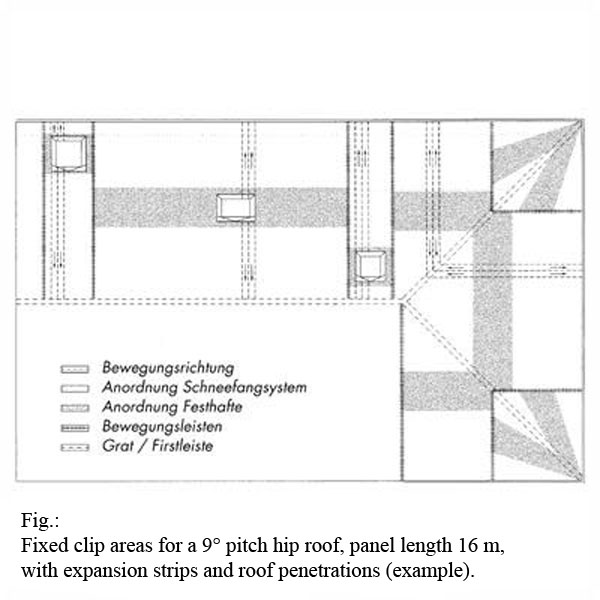
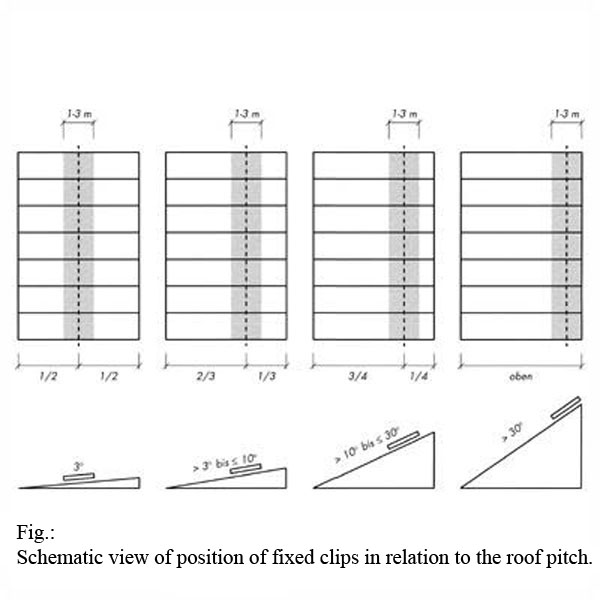
Depending on section length, the portion with the fixed fasteners can be between 1 and 3 m long, but not more than a quarter of the section length. |
Fixing Media
- Mainly flat headed nail or roofing felt nails
In Europe, flat headed nails and roofing felt nails have become the accepted fixing media.
Fixing RHEINZINK® roofing is primarily dependent on the type and design of the base construction. Construction requirements taking account of snow and wind loads, as well as course width and metal thickness must considered when selecting fixing media.
| Fixing Medium 2 each per clip Metal thickness 0,8mm |
Dimensions (in mm) | Quality | typ. Use in | Base construction (Comments s.b.) |
||
| 1 | 2 | 3 | ||||
| Flat headed nail for Compressed air nailer | 3,1x25 | hot zinc dipped | D | 508 | 889 | 1074 |
| Roofing felt nail | 2,8x25 | hot zinc dipped | D | - | 751 | - |
| Patented roofing felt nail | 2,8x25 | zinc-plated | A | 415 | - | - |
| Chipboard screw | 4,0x20 | zinc-plated | DK/D | - | - | 1262 |
| Chipboard screw | 4,0x25 | zinc-plated | DK/D | - | - | 982 |
| Roofing felt nail, threaded | 2,5x25 | zinc-plated | DK | - | - | 1019 |
| Countersunk wood screw | 4,5x25 | zinc-plated | DK | - | - | 533 |
| Threaded nail | 3,5x30 | coated | S | 829* | - | 1091* |
| Threaded nail | 2,4x30 | zinc-plated | F | 791* | 787* | - |
| Felt nail | 2,5x25 | hot zinc dipped | F | - | 503 | - |
| - | The combination was not taken into consideration with the measurements |
| * | The extraction values are higher in 30 mm thick wooden sheathing, as expected |
| 1 | Ta/Fi 24 mm wooden casing, V13 glass fibre bitumen roof sheeting |
| 2 | Ta/Fi 24 mm wooden casing |
| 3 | Building veneer plywood, waterproof, glued, 19mm, structured separator |
Table: medium static extraction values (in Newtons) of standard binding fixing media for RHEINZINK® seamed roofs and façades, depending on base construction
Cross-Joints
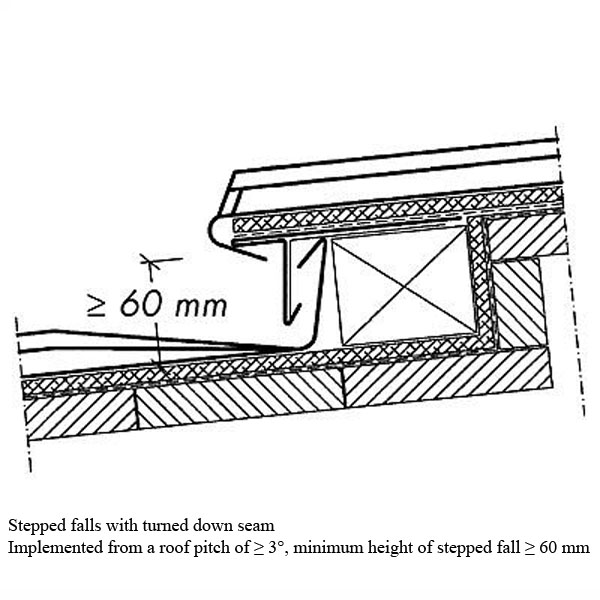
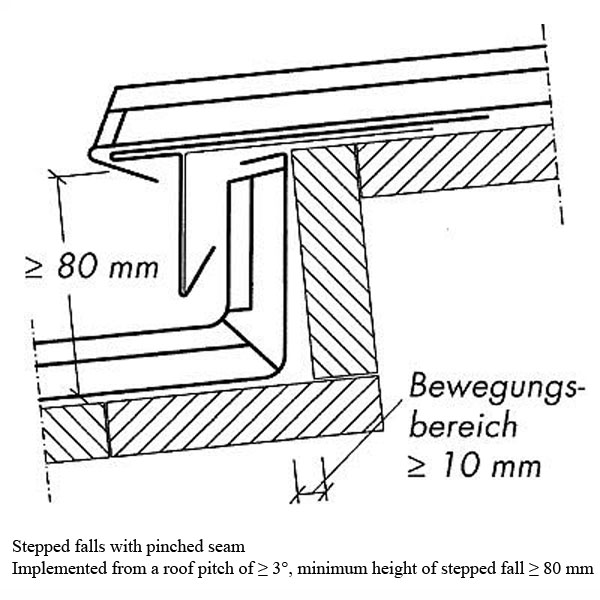
- Roof slope gradient level ≥ 3°
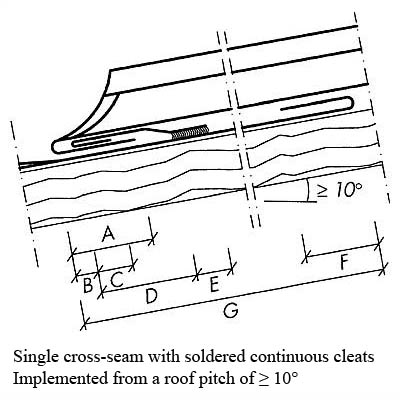
- Simple cross-seam with additional soldered-on binding strips roof slope ≥ 10°
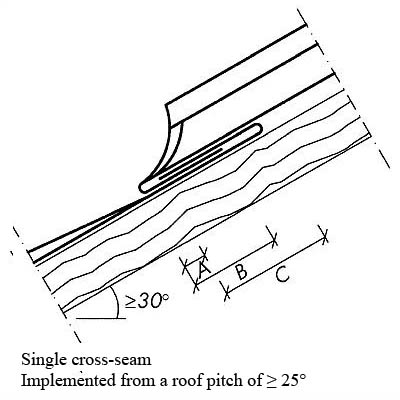
- Simple cross-seam, roof slope ≥ 25°
To separate over-long course lengths and for design reasons, cross-joins can be shaped. Shaping of cross-joins is dependant on the slope of the roof.
 |
Gradient Level
|
 |
Simple Cross-Seam with Soldered on additional Binding Strips
|
|||||
 |
Simple cross-seam
|