RHEINZINK® - Double Standing Seam
Construction
General
- Metal roofs can be produced in ventilated and non-ventilated designs.
The greatest and most persistent cause of moisture penetration is that of air drafts coming through gaps on the inside (convection). This is why DIN 4108, Heat Insulation in Buildings, Part 7: "Airtightness of Building Components", has expressly increased the requirements for gap seals.
Furthermore, roofing must also meet the criteria for required rainproofing.
Ventilated Roof Structure
- Use only building materials that are essentially dry.
- Cover open components during precipitation or expected precipitation, and when no one is working at the construction site.
- Use a vapour barrier on the interior side of the insulation layer.
- Ensure that the insulation layer itself and the layers on its interior side are installed without gaps (vapour barrier).
- For roof slopes of ≤ 15°, in areas with extreme weather conditions, basic measures for sealing the seams should be undertaken around the eaves.
Unless the influx of moisture can be prevented through special measures, the moisture must be removed through a layer of air that is connected to the outside. The "Guidelines for Metal Roofing" (ZVSHK/ ZVDH/ FVHF) classifies sub-roofs into four groups, depending on requirements.
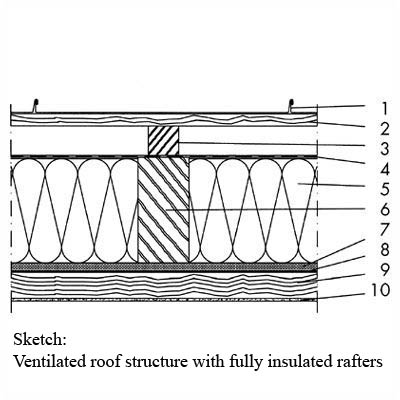 |
Roof Structure with Full Rafter Insulation
|

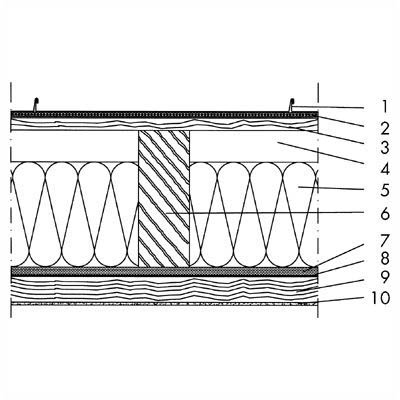 |
Roof Structure without Full Rafter Insulation
|
|||||
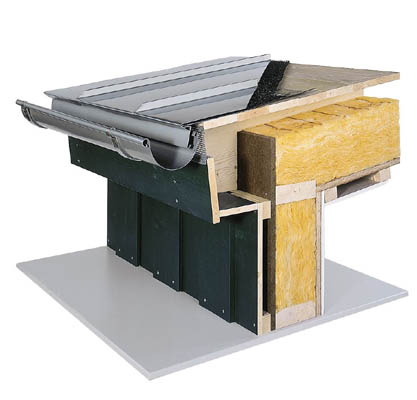 |
||||||
Air Intake and Exhaust
- Ensure that there is sufficient ventilation height.
The adjacent table lists the regulation values for ventilation height and width. Deviations from DIN 4108 are possible in isolated cases, based on structural physics.
| Roof pitch | Overhead clearance in space to be ventilated | Net groove width |
| ≥ 3° - ≤ 15° | 8 cm | ≥ 4 cm |
| > 15° | 4 cm | ≥ 3 cm |
Sub-roofs
As per "Guidelines for Metal Coverings" (ZVSHK/ ZVDH/ FVHF)
These are membranes which ensure the structure is able to breathe, but also offer protection from the rain. They are generally suspended over the rafters and held in place with nails or staples. The sheets are designed with an overlap of 10 cm to provide protection to all edges.
Rainproof membrane
Membranes consist of suspended breather membranes, which support the roof in providing protection from the rain. Individual strips are designed with an overlap of at least 10 cm at the edges, and are fastened to the substructure (e.g. rafters) with nails or staples.
Rainproof sub-coverings
Sub-coverings are made up of strips or panels on each side of the substructure. The counter-battening is mounted on top and not integrated into the sub-covering. To seal perforations caused by fasteners, additional sealant or caulking is used.
Rainproof sub-roof
Sub-roofs are built using waterproof strips. The seam and butt joints must also be waterproof. The counter-battening is not integrated. Perforations occur because of the fasteners of the counter-battening. These can be sealed by using sealant or caulking. Penetrations must be rainproof.
Waterproof sub-roof
This version is designed using waterproof sheeting and waterproofed seam and butt areas - made waterproof by glueing. The counter-battening is also integrated. Waterproof penetrations are also integrated. Openings and open penetrations caused by fastenings are not permitted. Contrary to other variations, blowing snow and driving rain is not permitted.
Underlays
- Depending on design and requirements, installation is possible with or without underlay.
Regardless of other viewpoints, installation coverings may be required during construction for protection against surface water.
Provided the underlays remain under the RHEINZINK® roof covering, no water can be absorbed or collected. As a rule, several underlays/installation coverings should not be placed one on top of the other, as this creates capillaries where water is collected.
Country-specific use of reinforced bituminous waterproof sheeting for roofs
| State | Make | Standard | Reinforcement | Use | Comments |
| DK | PF600 |
Glass fibre Glass fibre Glass fibre Glass fibre |
Façade Roof/Façade Roof Roof |
(1) | |
| D | V 13 Top TS 25/40 |
DIN 52143 DIN 52123 |
Glass fibre Thread |
Roof/Façade Roof/Façade |
(1) u. (2) (2) |
| GB | V 13 Top TS 25/40 |
DIN 52143 DIN 52123 |
Glass fibre Thread |
Roof/Façade Roof/Façade |
(2) (2) |
| NL | VB 240 B11 | NEN 6700/02 | Glass fibre | Roof/Façade | (1) u. (2) |
| N | U1 U2 U3 |
NS 3530 NS 3530 NS 3530 |
Glass fibre Glass fibre Thread |
Façade Roof Roof |
(2) u. (3) (2) u. (3) |
| S | YAP 2500 KOAP 2500 |
SS 236803 SS 236803 |
Glass fibre Glass fibre |
Roof Roof |
(2) u. (3) (4) |
| CH | F 12 Top TS 25/40 |
Glass fibre Thread |
Roof Roof/Façade |
(1) | |
| A | GV 20 GV 25 GV 35 |
ÖNORM B 3651 ÖNORM B 3651 ÖNORM B 3651 |
Glass fibre Glass fibre Glass fibre |
Roof/Façade Roof Roof |
(5) |
(1) Standard underlay
(2) Installation with approx. 10 cm butt overlap, max. spacing between nails ca. 30 cm
(3) Installation for roof slopes < 33 % (18°) across the direction of slope; adhesion with hot bitumen
(4) No underlays in the façade area
(5) Emergency covering in winter (welding procedure)
Underlays are not required:
- for protection against wood waterproofing material on RHEINZINK® roof systems with wooden sheathings and a roof pitch of ≥ 15°.
- for protection against wood waterproofing materials on RHEINZINK® façade systems
Underlays are required:
- to protect roof design and RHEINZINK® roofing systems, if substructures are made of: concrete, mortar and plywood sheets, (BFU, OSB / sterling boards, mineral-bonded chipboard, etc.) Foamglas, cement-bonded fibre sheets.
- to protect RHEINZINK® façade systems if substructures are made of concrete, mortar, Foamglas, cement-bonded fibre sheets
- on roofs with increased sound insulation requirements (noise reduction with structured separator approx. 6 dB A).
Structured Underlays
- must be installed if:
- roof pitches are ≤ 15° (according to DIN 18 339)
- non-porous sheathing (e.g. plywood sheets)
- non-ventilated roof construction
Structured underlays are underlays, which are permeable to diffusion, with an integrated drainage layer made of polyamide sheeting (approx. 6 mm - 8 mm high). However, structural braiding may also be installed in conjunction with standard roof sheeting suitable for metal roofs. RHEINZINK® can recommend specific makes upon request.
Advantages of the structured underlay
- Protection during construction (functions as an installation covering)
- Protection after construction (2nd function - discharge level), e.g. to divert melt-water
- Increased sound insulation (noise reduction function 6 dB)
- The polyamide braiding is environmentally - friendly and can be recycled.